 PANTHEONOF DISCIPLINE
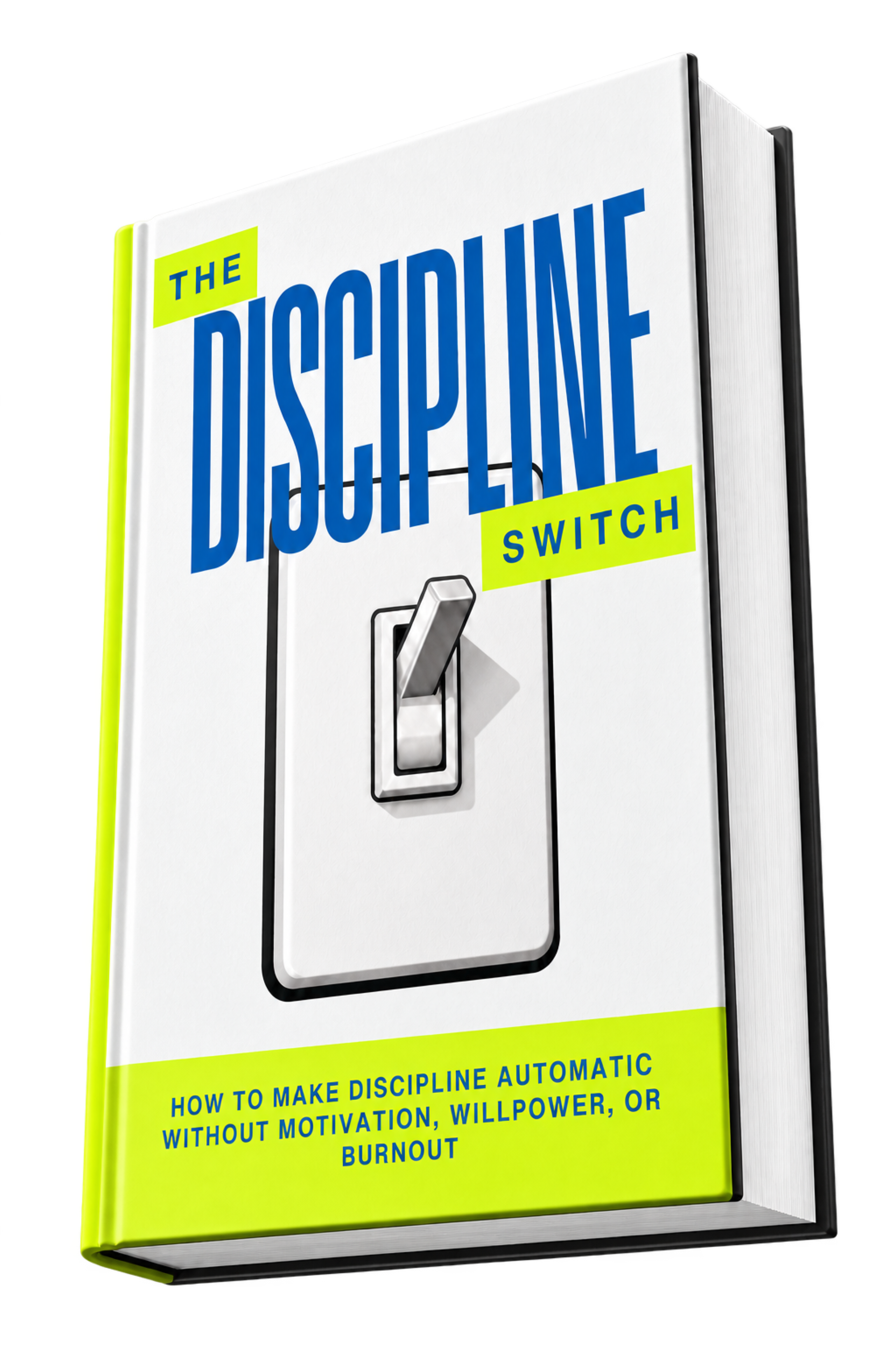
The DisciplineSwitch
How to Make Discipline Automatic Without Motivation, Willpower, or Burnout
Flip it once. Keep it on.
Stop depending on how you feel. Build a system that keeps working when motivation disappears. The Discipline Switch replaces emotional dependence with structure, friction reduction, and repeatable action.
You have been
disciplined before.
For a week. A month. A season. Then it faded.
The issue is not effort. It is instability. Most people activate emotionally but never install systems that maintain power.
- Distraction fragments attention.
- Convenience lowers resistance.
- Undefined routines create drift.
- Daily self-negotiation drains execution.
You do not fail because you are lazy. You fail because the machine powers down. This book addresses that directly.
Discipline becomes
baseline, not intensity.
Replace motivation with structure
Build a system that still runs on low-energy days.
Eliminate daily self-negotiation
Reduce the internal debate that delays useful action.
Build automatic execution loops
Make the next right action easier to begin and repeat.
Reduce friction
Design surroundings that support action instead of resistance.
Detect drift before collapse
Notice disruption early and return without starting over.
Reinforce identity
Rebuild self-trust through evidence, not promises.
Discipline is
operational.
Remove friction
Make useful action easier to begin instead of demanding more force.
Act before confidence
Confidence is often the result of repeated action, not a requirement for starting.
Choose consistency
A smaller action that survives real life beats a dramatic routine that collapses.
Use return logic
A missed day is a disruption, not a new identity. Return instead of restarting.
For people tired of
inconsistency.
Entrepreneurs
Who need stable output, not occasional bursts.
Students
Who are finished with restart cycles.
Professionals
Who want reliability under pressure.
Builders
Who value structure over hype.
If you want inspiration, this is not it. If you want activation that lasts, it is.
What The Discipline Switch teaches
The Discipline Switch is a practical philosophy of self-discipline built around one central claim: discipline is not a mood, a personality trait, or a temporary burst of willpower. It is a system of repeated choices that aligns daily behavior with long-term outcomes. Chance Gibbons argues that most people do not need to discover discipline from scratch. They are already repeating patterns with remarkable consistency. The real challenge is to recognize where those patterns are pointing, redirect them intentionally, and keep the new direction stable long enough for it to become normal.
Part IThe Discipline Ways
The opening section defines discipline as controlled, sustainable commitment rather than extremism. Discipline exists between two failures: doing too little to make progress and applying so much rigidity that life, health, and relationships suffer. The book presents discipline as a range that rises and falls from day to day. Perfection is not required; maintaining a dependable minimum standard is. Progress comes from accumulating enough disciplined days, not from producing a flawless performance every morning.
This part also explains why the path is never perfectly linear. Resistance, changing circumstances, low-energy days, and setbacks are not evidence that the system has failed. They are normal conditions inside the journey. When discipline is practiced consistently, it stops feeling like an outside demand and becomes an operating system: a stable way of thinking, deciding, and acting that can support growth without chaos or burnout.
Part IIThe Discipline Truths
The second section challenges the belief that waiting is neutral. Time keeps moving whether a person chooses deliberately or allows convenience, habit, and circumstance to choose instead. Inaction therefore has a direction. Every repeated behavior is already training a future outcome, which means people are often highly disciplined at maintaining the life they say they want to change.
Gibbons describes this as an invisible system. Repetition is always operating, but it may be aimed at comfort, avoidance, distraction, or familiar routines. Discipline amplifies direction; it does not automatically correct it. Once the direction changes, identity initially lags behind behavior. The new actions can feel unnatural because the self-image was built from years of older evidence. Repetition eventually closes that gap. Small actions accumulate statistically, friction confirms that an old path is being disrupted, and alignment among values, habits, environment, and identity gradually reduces the need for force. The conclusion is direct: discipline is inevitable. Everyone lives under repeated patterns. The meaningful choice is whether those patterns preserve the present or construct the intended future.
Part IIIThe Discipline Within
This section applies discipline to goals, enjoyment, authenticity, health, and everyday life. Goals give discipline a destination, but a goal must be translated into specific daily behavior. Vague ambition creates no reliable action. Clear outcomes, realistic steps, and repeated execution turn a desired future into a path that can actually be followed.
Discipline is not presented as the removal of enjoyment. It creates enjoyment that is sustainable and free from the guilt of neglected responsibilities. Nor is discipline meant to erase individuality. Authenticity requires the strength to align actions with real values despite pressure, impulse, or convenience. In health and fitness, discipline replaces inconsistent intensity with a stable baseline of movement, nutrition, recovery, and self-respect. As these principles spread into more areas of life, discipline becomes less like a special technique and more like an integrated identity.
Part IVThe Discipline Laws and Effects
The longest section explains the laws that govern disciplined action. Presence places attention on the current decision instead of an imagined future. Attention determines what receives energy. Subtraction removes distractions and unnecessary choices before more effort is added. Small decisions matter because they compound into character, standards, and outcomes. Consequences may be delayed, but they still arrive.
The law of first action shows that beginning changes the emotional and practical conditions of a task. Momentum then reduces the cost of continuing. Standards create a floor for behavior when motivation disappears. Meaning makes difficulty easier to carry because the effort serves a chosen purpose. Delay exposes the trade between short-term comfort and long-term regret, while action converts thought into evidence. Time magnifies whatever is repeated, and identity forms from the votes cast by daily behavior. Together, these laws replace vague inspiration with cause and effect. They show that disciplined outcomes are not mysterious. Attention, environment, choices, standards, action, and time interact predictably. When the inputs remain aligned, the results become increasingly difficult to avoid.
Part VThe Discipline Formulas
The formulas turn the philosophy into decision rules: logic over emotion, future over now, discipline over motivation, decision over delay, action over thinking, clarity over complexity, environment over willpower, consistency over intensity, and systems over goals. These are not demands to suppress emotion or abandon goals. They establish which factor should lead when competing impulses appear.
Logic asks where a repeated choice will eventually lead. The future deserves representation in present decisions. Motivation may help begin, but discipline must carry the process after the feeling fades. Action creates information that overthinking cannot. Clarity lowers the number of decisions required, while a well-designed environment makes useful behavior easier and unwanted behavior harder. Consistency survives real life better than dramatic surges of effort. Finally, systems translate a distant goal into something repeatable today. Goals point; systems move.
Part VIThe Discipline Awakening
Here the book introduces the switch as a decision to operate from alignment. Turning it on does not remove difficulty. It removes the assumption that action must wait for the correct emotional state. Each aligned choice reinforces the decision, and repeated choices make outcomes more predictable. Discipline becomes a way of building character and, through character, destiny.
It also creates functional freedom. Structure narrows certain present options so that the future contains more health, capacity, financial control, confidence, and opportunity. What appears to be luck is often disciplined readiness meeting chance. Success is likewise reframed as the accumulated byproduct of daily actions rather than a single arrival point. In this view, practicing discipline is not merely preparation for success; it is success already taking place in repeatable form.
Part VIIThe Discipline Framework
The framework connects the earlier ideas into one usable system. Information by itself does not change a life. Ideas become useful when their relationships are understood: direction gives repetition a destination; subtraction and environmental design reduce friction; first action creates momentum; consistency allows actions to compound; repeated evidence updates identity; and identity makes aligned behavior increasingly natural.
Knowledge becomes understanding when it is organized, and understanding becomes wisdom when it changes decisions. The reader is therefore encouraged to stop collecting disconnected advice and begin applying a smaller number of connected principles. Discipline is strongest when it becomes integrated across work, health, relationships, thought, and action rather than reserved for isolated challenges.
Part VIIIThe Discipline Switch
The final section brings the argument back to choice. A person can accept the discomfort of change or remain with the eventual pain of regret. The switch is the decision to treat discomfort as part of progress instead of proof that something is wrong. Once the switch is on, the decisive internal change is the removal of negotiation. Tiredness, stress, boredom, and uncertainty may still be present, but they no longer receive automatic authority over the next action.
The switch must be renewed through behavior today and again tomorrow. It is strengthened each time a person chooses the future over immediate comfort, action over delay, clarity over confusion, and a stable system over temporary motivation. Over time, the disciplined action stops feeling foreign because identity catches up with the accumulated proof. Discipline is no longer something being chased. It becomes the default position of life.
About
the book.
What is The Discipline Switch about?
It explains how to build sustainable discipline without depending on motivation or constant willpower through structure, friction reduction, calm consistency, and quick return after disruption.
Is this a motivation book?
No. It is deliberately designed as an alternative to motivational hype. Discipline is treated as a system that should work when enthusiasm is low.
Is this book about habits?
It overlaps with habits, but focuses on resistance, returning, and reliable action.
Who is it for?
People tired of starting over and ready to replace intensity with structure.

STOP CHASING DISCIPLINE.
SWITCH IT ON.
Choose your edition and start building consistency that survives real life.